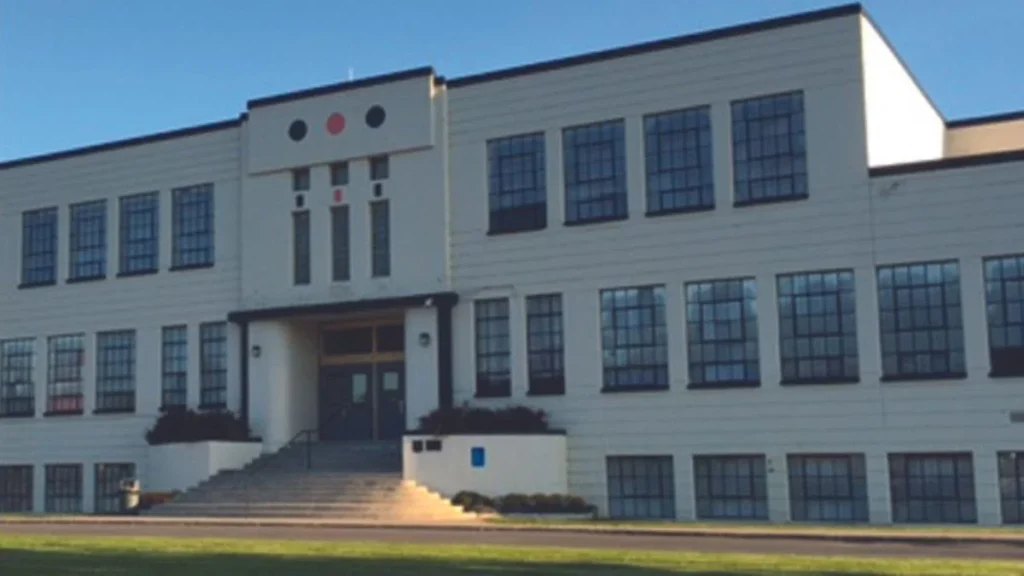
C. 1940
The current Junior High School was originally conceived of in the late 1930’s as a new school for over 200 displaced high school students. According to the advertisement for the school bond election in 1939, grade school enrolments with over 400 and the district lacked adequate facilities for its growing high school population.
But before we get into the school, a quick history lesson. After the period of the great depression in the US, the Federal Government began pumping Millions of dollars into the states to help right the economic ship. The State of Idaho received $321 million dollars in federal aid. The WPA (works projects administration) received over $23 million dollars to put people back to work. The money was used to build nearly 80 new schools in Idaho.
So, in May 1938, the Federal Government awarded the Independent School District #13 nearly $32,000 to build its new school. This money had to be matched by a local bond of $58,000 to complete the school. The levy would cost the average homeowner (the average home value being $400) $1.20. According to the ad for the levy, “This compared to the tax of 6c per pack of cigarettes or a total of $18.00 which the average smoker pays every year..” One of the main selling points of the new school was the ability to offer new practical subject areas of Home Economics and Manual Art (The school was later home to the first sheet metal training program in the State). As with today, the citizens supported the levy and it passed in October 1939 on a vote of 233 to 30. In an article outlining the bond election, much discussion was given to the buildings location.
“The matter of locating the school is causing considerable discussion throughout the community. The board of directors recognize that the particular location of the new building is indeed an important matter. While it will be quite impossible to so locate the building as to please everyone concerned, yet in order to get the best judgment of the community, the school directors plan to invite representative citizens to become members of a location committee which will study every angle of the matter so as to insure the best possible location. No decision has been attempted nor will the matter be gone until the passage of the bond issue justifies an attempt at location.”
The article went on to highlight the importance of the election. “No serious opposition to the bonds is anticipated as it is generally conceded that the new building is a necessity. The new and enlarged enrollment in the grade school already taxes the capacity of the old building, and it is hard to believe that any right thinking citizen would wish to perpetuate the distracted classroom organization now being used to accommodate the high school students.”
The Architect for the project would be G.A. Pehrson from Spokane. He was best known at the time for designing the 1924 Chancery Building, the 1929 Paulsen Center and the 1930 Rookery Building in Spokane.
After much deliberation, the site of the new school was picked in October 1939. The school district picked a 10 acre tract of land on the western edge of town adjacent to a log yard just to the West. They purchased the property from the Charles Beardmore Estate.
The land was cleared in November and December of 1939 and the concrete footings were in by the end of January 1940. The basement walls took until April 1940 due to a shortage of labor, especially carpenters. By mid July the upper story poured concrete walls were complete and by September 1940 the school was ready to open. On September 30, 1940 all of the school children from the old elementary school (now the site of the Senior Center and park complex) marched on highway 2 to the grand opening of the new school. According to newspaper accounts, Ross Hall was to shoot two video tape of the march and grand opening. One of the video’s was to stay with the school and one was to be placed in his collection.
As the main school building (the center section) was being finished, the gymnasium was also started using additional Federal aid. The gym was finished in the Fall of 1941 and the residents held a dedication dance on November 1, 1941. The students at the grade and high schools sponsored the dance to raise money to convert the old manual training shop into a student recreation hall. Nearly 300 tickets were sold for the event that raised $170.00.
Before the gym was complete, the district decided to move ahead with the 3rd leg of the project, the auditorium. With $1100 of remaining funds from the other 2 projects and enough man hours to do the job, work began on the auditorium in September/October of 1941. An additional federal appropriation of $27,794 was later announced in January 1942 with the belief that the auditorium would be completed soon. The auditorium ended up taking over 11 years to complete. It is believed that America’s entrance into WWII took many of the workers and delayed the project.
According to the application for recognition on the National Register of Historic Buildings in 1995, much of the interior and exterior of the building had not changed since it was completed. A few windows had been taken out over time and filled in as an energy conservation measure but other than that, the building has remained the same for 70 years. Also in 1995 there was a campaign to “spruce up” the junior high with new paint.
In the last 12 months the front of the school has taken on a new look. After the wind storm destroyed trees in the front of the school, a group of local residents decided it was time for a facelift for the school. With much hard work, persistence and some begging, the group was able to make a 70 year old building look bright and new again without losing the character of its 1930’s design. It truly was a testament to what a group of determined citizens can accomplish. One founding principle of our foundation is service to our community. Because of all of this, our foundation wishes to recognize Rusty Pavey, Dana Douglas, Chris Yount, Casey Johnson, Gary Go and all the other volunteers for their hard work, determination, vision and willingness to give back to our community.
I also want to thank Marylyn Cork for the great information she provided this year and every year for our historical buildings.
Also, many of our local residents were hired on to this project back in 1939/1940 to help construct the building and one is with us tonight.